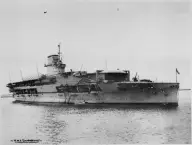
Admiral , commander of the British Mediterranean Fleet, knows from , which has just broken the Italian navy's Enigma code, that Admiral has put to sea with the fast battleship , cruisers and destroyers to intercept the British troop convoys bound for Greece. To cover this source, Cunningham has the enemy "discovered" by a flying boat, then slips out of Alexandria after dark on 27 March with 3 battleships, the aircraft carrier and destroyers.
On the morning of 28 March, the cruisers of Admiral make contact with the Italian squadron south of Crete, then fall back. At midday, Iachino breaks off and heads for Taranto.
The 's torpedo bombers give chase. Around 3 p.m., a torpedo strikes the , which nevertheless gets under way again at 19 knots. At dusk, a last attack stops the heavy cruiser Pola dead in the water; Iachino sends the cruisers Zara and Fiume and destroyers back to her. The keeps her lead.
Cunningham must decide: pursue through the night with his battleships, counting on the radar the Italians lack, at the risk of confusion and enemy torpedoes; wait for dawn to send the 's aircraft in again and fight by day; or break off and return to Alexandria before the morning air raids.
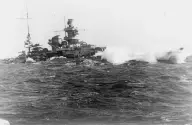
Cunningham pursued through the night with his battleships, counting on radar. In the evening, British radar picked up the stationary Pola; around 10 p.m., it detected the cruisers that had come to her aid, which suspected nothing: the Italian navy had no radar and was not prepared for night fighting. At about 10:20 p.m., the battleships , Valiant and Barham, lighting up their targets with searchlights, opened fire at under 3,500 metres. Within minutes, the heavy cruisers Zara and Fiume and 2 destroyers were destroyed; the Pola was finished off before dawn. Some 2,300 Italian sailors died, while the British lost only one aircraft and 3 airmen. The nevertheless got away, which Cunningham regretted. The Battle of Cape Matapan was the greatest Allied naval victory in the Mediterranean: it broke the boldness of the for a long time, as it would no longer risk its big ships so far afield, and secured British communications just as Greece was collapsing.
T07-006