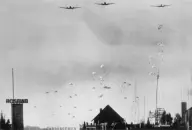
On the morning of 9 April 1940, Hauptmann (Captain) is leading a group of Luftwaffe Junkers Ju 52s tasked with landing an infantry battalion, , at airfield, on the outskirts of . The German plan is timed to the minute: Fallschirmjäger (paratroopers) are to jump first and neutralise the defence, then Wagner's transports will land the infantry who are to march on the capital.
But over the North Sea, thick fog scatters the formations. The drop on fails: lost in the mist, the paratroopers' aircraft turn back. The airfield is therefore not held, and Norwegian Gladiator fighters and anti-aircraft machine guns are still defending the runway. In the , the naval squadron that was to land troops at has also been stopped.
In flight, Wagner receives an order from General 's to turn back. Yet the message does not reach him through the agreed channel, the officer in charge of air transport on the ground. Wagner suspects an enemy ruse, just as his aircraft are approaching a defended airfield.
Wagner must decide: hold course for despite a recall order he judges suspect; divert to another airfield already in German hands; or turn back and obey the recall order.
Wagner holds course for despite a recall order he judges suspect: convinced he is facing a ruse, he carries on with his mission. During the descent to the runway his Ju 52 is hit by anti-aircraft fire and Wagner is killed. The escorting Bf 110 heavy fighters of Oberleutnant Hansen, short of fuel, then land on the field and cover with their guns the transports that come in after them. By about 11:00 most of is on the ground and takes over the defence of the airfield, which fell during the morning. That same day is occupied by airlifted troops, making up for the squadron's failure in the . The capture of , pressed on against the order received in flight, becomes one of the first great successes of air-landed transport in the war, paid for with the life of the man who held to it.
T03-070