Since 1937 has headed a design bureau at Factory No. 183 in Kharkiv, which builds the fast BT tanks. Their running gear, inherited from the Christie chassis, is convertible: the tank runs on tracks over rough ground and on wheels on the road. On 13 October 1937, the Red Army ordered from the factory a successor built on the same principle, the BT-20, or A-20.
With his deputy , Koshkin doubts this mechanism: heavy, fragile and costly, it rules out thicker armour against modern anti-tank guns. These doubts are spreading through part of the military hierarchy, and in 1938 the bureau studied a purely tracked variant, simpler and sturdier, named A-32 after the 32 mm of its frontal armour.
In February 1939, the USSR Defence Committee must settle the prototype programme. Officers attached to a “cavalry” tank demand that only the wheel-cum-track A-20 be built; others fear that an overloaded bureau cannot deliver 2 prototypes in time.
Koshkin must choose his line: give up the new chassis and settle for modernising the existing BT-7; comply with the specification and present only the A-20, as the command wishes; or demand that the purely tracked A-32 be built as well, so that trials can decide between the 2 solutions, at the risk of clashing with established doctrine.
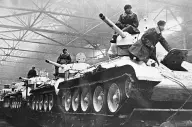
Koshkin insists that the purely tracked A-32 be built too, and his persistence carries the day: the Defence Committee funds both prototypes. Completed in May 1939, the A-20 and A-32 are tested over the summer. The A-32 proves as mobile as the A-20 across country while offering a margin for extra armour that the convertible running gear ruled out. After both are shown at the Kubinka proving ground in late September 1939 to the leaders of the Defence Commissariat and the government, the Defence Committee adopts on 19 December 1939 a version of the A-32 with armour increased to 45 mm, under the name T-34. The wheel-cum-track running gear, long held sacred, is abandoned. Koshkin dies of illness on 26 September 1940, worn out by the trials of his tank, just as series production begins.
T00-076