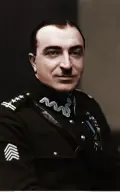
, 29, is a second-lieutenant pilot of the (Eskadra) of III Group of the 2nd Krakow Aviation Regiment, based at Balice (the future international airport). His unit flies the PZL P.11c — a high-wing monoplane fighter designed in 1934, already obsolete against the Luftwaffe's Messerschmitt Bf 109 (350 km/h against 550 km/h). On the evening of 31 August, the squadron is dispersed preventively to field bases (Borowiec, Aleksandrowice).
On 1 September 1939 at about 6:30 a.m., Gnyś takes off alongside Captain , the group commander, to intercept a German formation approaching Krakow. The 2 fighters are at once surprised by Ju 87 dive bombers of I./StG 2.
The Stuka of Unteroffizier shoots down Medwecki, who becomes the first aerial casualty of the war. Gnyś manages to break away and, a few minutes later, spots 2 Dornier Do 17s of () heading toward Olkusz.
Gnyś attacks from the rear at 200 metres, with a concentrated burst on the first Dornier. At 7:02 a.m., he shoots down the first Dornier Do 17, which crashes near the village of Żurada. An 8-second burst from his 4 machine guns (2 7.92 mm Vickers, 2 7.92 mm Browning wz. 36 in the wings). He follows up on the second Dornier, which he damages severely — it crashes nearby, the German crew killed. has just achieved the first Allied aerial victories of the Second World War. He will be hailed by Polish propaganda and then by the British after his escape. In September 1939: 4 confirmed victories. Escaped via Romania in November, he joins France and then the United Kingdom in June 1940. He serves in of the RAF during the Battle of Britain (3 additional victories). Surviving the war, he emigrates to Canada (Beamsville, Ontario), where he dies in February 2000. The Gnyś monument is erected at Żurada in 2014. The very first aerial victory of the war probably belongs to Unteroffizier , whose Stuka shot down Medwecki; historians credit Gnyś with both Dorniers, even if one may have struck the other as it fell.
T01-081