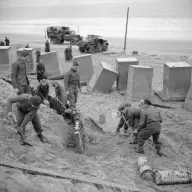
Built between 1928 and 1936 at the initiative of War Minister , the line that bears his name is the most modern frontier fortification in Europe: 142 ouvrages spaced over 390 km, from Belgium to Switzerland, 2 billion francs of investment and, at its peak, a garrison of some 400,000 men. Everything rests on static defence: artillery in armoured cupolas, underground galleries as deep as 30 m, complete living quarters — kitchens, dormitories, hospitals, cinemas.
By autumn 1939, with mobilisation complete, around 600,000 French soldiers are deployed along the line. But the doctrine is already obsolete: the Maginot does not cover the Belgian frontier, left "neutral" by the agreement of 1936, and the Saar offensive launched in September has had to be wound back by 4 October.
From October 1939 the front freezes: no more fighting, no more patrols. The typical soldier is 24; a peasant or a worker from Brittany or the Limousin, mobilised since 1 September without a single leave, his regiment having marched 200 km on foot to the Moselle. At the Ouvrage du Hackenberg, the largest of the Maginot works with its 19 blocks and 1,081 men, daily life settles into an unchanging routine: reveille at 05:30, maintenance work from 06:30 to 12:00, meals where meat appears 4 days a week and the mandatory 0.25 L quart of wine is served, more work from 14:00 to 18:00, evening leave until 22:00, then lights out at 23:00. The command must organise this garrison life for 8 months, with no certainty whatever as to what comes next.
The French high command (Gamelin, Georges) stakes everything on cultural programmes and entertainment. During the winter of 1939-1940 a service for "reading, arts and leisure for the armies" is set up to coordinate the troops' distractions: army theatre shows, cinema, sport, visits by stars such as . Training takes a back seat and inaction wears down morale: despite these efforts, boredom feeds indiscipline and drunkenness in part of the units. , in L'Étrange Défaite, written in the summer of 1940, would analyse the intellectual and moral failings of the command that led to the debacle. When the German offensive of 10 May 1940 breaks, the Sichelschnitt bypasses the line through the Ardennes. Hackenberg is never attacked directly: in June its guns support the neighbouring positions and harass the Germans, and its garrison only surrenders a few days after the armistice of 22 June 1940, on the orders of the French authorities. The Maginot Line nonetheless becomes the symbol of the French defeat. Today, several works (Hackenberg, Schoenenbourg, Simserhof) are museums.
T02-010