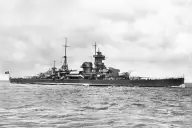
Capitaine de vaisseau has commanded, since December 1940, the Groupement occasionnel, the small French squadron assembled at Cam Ranh for the Franco-Thai War: the old cruiser and 4 sloops. Tasked by Admiral on 13 January 1941 with striking the Thai navy, he chose to attack the anchorage at at dawn rather than the base at , which was farther away and little known.
On 17 January surprise paid off. The 2 Thai torpedo boats present were sent to the bottom. The coastal defense ship , armed with 4 203 mm guns, returned fire before being badly hit: at around 07:50 she is burning, listing heavily, and disappears behind an island into shallows where the French ships will not venture.
Bérenger is fighting without air cover: the 's 2 seaplanes could not be catapulted. Thai aircraft, expected at any moment, may fall on an isolated squadron far from its bases. 's orders also targeted the ports of the Thai coast, from Rayong to the Cambodian border.
Bérenger must decide how far to press the advantage: steam into the shallows to finish off the and make the victory complete; break off the action and bring the squadron back intact to Saigon before the air raids; or extend the raid to the Thai coastal ports, as his orders provided.
Bérenger broke off the action and brought the squadron back intact to Saigon: at 08:40 he ordered the return, just as the expected Thai air attacks began. One bomb hit the without exploding, and the last raid, at around 09:40, achieved nothing. The tally was clear: the torpedo boats Songkhla and Chonburi were sunk, and the burning ran aground and then capsized in shallow water before being refloated and repaired, while the French lost no ship and counted 11 dead. Yet it was a tactical victory without strategic effect: Japan at once imposed its mediation, an armistice was signed on 31 January 1941 aboard the Japanese cruiser , and the Treaty of Tokyo, in May, left Laotian and Cambodian territories to Thailand.

T06-009