, aged 59, runs production at Ford; Henry Ford nicknamed him "Cast Iron Charlie" for his foundry innovations. In January 1941, he accompanies , the company's president, to , to , which builds the heavy bomber. Washington wants to bring the car industry into the air rearmament drive.
Ford knows little about aviation: the firm has not built an aircraft since its Trimotor was discontinued in the early 1930s. Sorensen therefore studies Consolidated's methods with a car engineer's eye: wing and fuselage sections put together by hand, final assembly out of doors, under the California sun, on steel fixtures that the heat distorts. Output is in the order of one bomber a day.
Consolidated's president, , and the Air Corps are considering giving Ford sub-assemblies to make; Fleet offers a contract for 1,000 wing sections. Sorensen doubts that precision parts machined in Detroit would fit aircraft assembled in such conditions.
Asked how he would do it, Sorensen promises an answer by the next morning. He must decide: accept the wing-section contract offered by Fleet; stick to the Pratt & Whitney aero engines Ford has already been ordered to build; or insist on building the entire aircraft, on a moving line, in a new plant yet to be built.
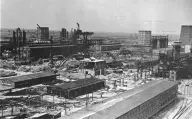
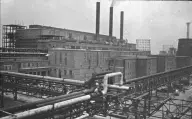
Sorensen insisted on building the entire bomber on a moving line: "We'll make the complete airplane or nothing," he told Fleet. That night, in his room at the Coronado Hotel, he broke the B-24 down into major assemblies and sketched a plant a mile long, designed to turn out one aircraft an hour; at breakfast, gave his approval. The Army at first confined Ford to parts and kits, assembled by Consolidated and Douglas, and only allowed complete aircraft to be assembled at , Michigan, in October 1941. The site, broken on 18 April 1941, had a painful start: the plant, soon nicknamed "Will it run?", delivered only 56 net aircraft in 1942. Yet the method paid off in the end: in March 1944, turned out 453 aircraft in 468 working hours, and in all it delivered 6,792 complete Liberators and 1,893 kits, a symbol of American industrial might.
T07-051