To counter the German occupation of Norway, London launches Operation Sickle: a landing at Åndalsnes (west coast, Romsdalen fjord) to attack Trondheim from the south. Force "Sickleforce": 5,000 men of the and the , commanded by Major-General , 52. Mission: to take Dombås, which locks the railway line to Trondheim, then to advance on Lillehammer.
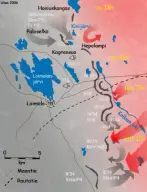
Landing at Åndalsnes on 18 April 1940 without initial opposition. But the equipment is unsuited: summer kit for soldiers advancing through 1.5 m of snow, no skis, no heavy artillery, no air support (the local airstrips are frozen). Opposite advances the German under General Pellengahr, coming up from the south with massive air support — the Stukas of and 2 harry the British troops in stretched-out columns.
On 23 April, first unfavourable engagement at Tretten: the 148th Brigade is driven back with losses. The logistics buckle. Paget must decide what comes next: try to hold, abandon, or push on to Trondheim regardless.
Paget chooses to evacuate immediately to avoid a Gallipoli-style catastrophe. From 30 April to 2 May 1940, Sickleforce is evacuated under continuous Luftwaffe bombardment. 5,000 men brought back to Scapa Flow by destroyers. Balance: 1,300 killed or taken prisoner, heavy equipment abandoned, 17 British destroyers damaged by the Stukas. Åndalsnes is the first major Allied setback of the war. The parliamentary debate that follows — the Norway Debate — brings down Chamberlain. Paget returns to service: Commander-in-Chief Home Forces from 1941, he also leads 21st Army Group in 1943 before Montgomery, then serves as Commander-in-Chief Middle East from 1944 to 1946. He survives the war and dies in 1961. Strategic lesson taken on board by Dowding and the RAF staff: the Luftwaffe dominates the Channel and the North Sea. That lesson will shape British air defence doctrine for the Battle of Britain.

T03-013