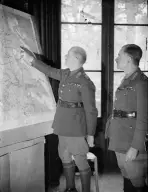
General , 73, formerly Foch's chief of staff, takes command of the French armies at Vincennes on 20 May 1940. summoned him from Beirut on 17 May to replace General , commander-in-chief of the land forces since September 1939, whom he considers overwhelmed by the German breakthrough at Sedan.
The situation is critical. The German armoured divisions are racing for the Channel along the Somme valley and cutting the Allied line in 2: in the north, the French armies, 's British Expeditionary Force and the Belgian army face encirclement. On 20 May, the German spearheads reach and the sea.
Before leaving, Gamelin signed his Personal Instruction No. 12 on 19 May, ordering attacks on the German corridor from the north and from the Somme at once. Weygand knows neither the real state of the northern armies nor that of their commanders, and every hour counts.
Weygand must set his course: take up the pincer counter-attack himself to cut the armoured corridor and restore the link with the north; pull the line back to the Seine, even if it means leaving the northern armies to their fate; or put the question of an armistice to the government at once to spare further losses.
Weygand chooses the pincer counter-attack, but first suspends Gamelin's Instruction No. 12 so as to judge for himself. On 21 May he flies north and meets King at , then General ; he leaves before the arrival of , who had not been told in time. His plan is essentially Gamelin's, 3 days late. Returning from the conference on the night of 21–22 May, Billotte's car hits a lorry at Locre; he dies on 23 May, and it takes several days for General to be confirmed in his place. Coordination unravels, the attack from the Somme never comes, and on the evening of 25 May Gort abandons the offensive southward and falls back towards Dunkirk. Weygand, who now considers an armistice inevitable, is the first to demand one in June. Pétain's Minister of National Defence until September 1940, then Delegate General in North Africa, he is arrested by the Germans in November 1942 and held until May 1945, finally at . The charges against him are dismissed in 1948 and he dies in 1965. Gamelin, arrested by Vichy in September 1940 and tried at Riom in 1942, is handed over to the Germans in 1943, held near Buchenwald and then at Itter, and freed in May 1945; he dies in 1958.


T03-025