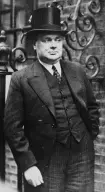
, Governor of the since July 1937, ordered in May 1939 the whole gold reserve to be concentrated south of the Loire and west of the Cévennes; the last transfers are completed in the first days of September. More than 2,000 tonnes of gold now lie in the branches of the interior.
In November 1939 Roosevelt wins cash and carry from Congress: belligerents may buy arms in the United States provided they pay cash, in dollars or gold, and carry them away themselves. France, which wants American aircraft and equipment, must be able to pay for its orders across the Atlantic, where only 40 tonnes of its gold are held.
Any shipment would have to travel aboard the cruisers and battleships of the French Navy, under the threat of U-boats. For America, since a belligerent warship may not stay more than 24 hours in a neutral port, the gold would have to be unloaded at , in Canada, which is at war, to reach the . London is closer, but within reach of German bombers.
Fournier must choose where to place the gold: keep most of it in France and the Empire, sending only the bare minimum; entrust part of it to the Bank of England in London; or ship it in instalments to New York, via , to back the arms purchases.
Fournier ships the gold in instalments to New York, via . Between November 1939 and March 1940, 350 tonnes cross the Atlantic: 100 tonnes leave Toulon on 14 November 1939, 100 tonnes sail from Brest aboard the battleship on 13 December, and 150 tonnes leave Toulon on 12 March 1940. The rule is to send enough to guarantee the contracts, but not so much that the gold could become a lever on French decisions. The German offensive of May 1940 forces out the rest: new convoys reach and Casablanca; the cruiser , which leaves Brest on 11 June with 254 tonnes, is diverted to on 's orders; and the remaining 736 tonnes leave Brest for Dakar before being hidden at , in French Sudan. In all, some 2,080 tonnes escape the Germans and stay frozen throughout the war. The only loss concerns the Belgian gold entrusted to France, which Vichy hands over to the : after the war the repays Belgium and recovers only part of it. Fournier leaves the Bank at the end of August 1940 and in September takes over as head of the SNCF.
T02-060