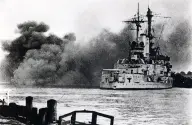
The Free City of Danzig, placed under the authority of the League of Nations but populated in its overwhelming majority by Germans, has become the seat of the crisis. Its Senate, dominated by 's local Nazis, multiplies provocations: clandestine importation of arms, formation of paramilitary militias, harassment of Polish officials.
Poland holds rights there — customs, access to the port, diplomatic representation — which it intends to defend. During the summer of 1939, a quarrel breaks out over the Polish customs inspectors, whom the Danzig authorities wish to oust. The affair becomes a test of will.
Beck's government must calibrate its response. To address a firm ultimatum to Danzig, warning that any attempt at annexation or infringement of Polish rights would be considered a casus belli? To compromise so as not to offer Berlin a pretext for intervention? Or to respond with measured firmness, defending Polish rights without yielding to escalation? Every incident at Danzig can serve as a spark, and all of Europe watches for Warsaw's reaction.
Warsaw sends an ultimatum to Danzig and treats any infringement of its rights as a casus belli: on 4 August 1939, when the Danzig customs try to remove the Polish inspectors, the Polish government demands an assurance by 6 p.m. the next day that they may carry out their duties, failing which it will react in the strongest manner, and the Danzig Senate gives way. On 10 August, Warsaw answers Berlin that it would regard any intervention by the Reich to the detriment of Polish rights in Danzig as an act of aggression. The customs quarrel subsides provisionally, but the tension remains: Danzig stays the fuse Hitler intends to light. Polish firmness, supported by the British guarantee, seals the impossibility of a negotiated settlement and brings the reckoning nearer. Berlin, for its part, continues to stoke tensions at Danzig, of which it makes the avowed pretext for its demands.

T00-024