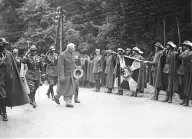
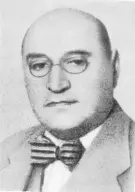
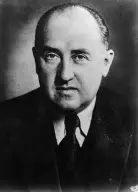
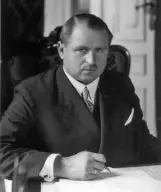
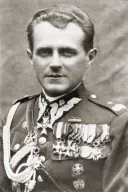
, 45, has been Polish Foreign Minister since November 1932 — one of the longest diplomatic tenures in interwar Europe. Architect of Sanacja's foreign policy, he held to a doctrine of equilibrium: refusing to align Poland on Berlin or Moscow. In the wake of Munich, he had secured the Polish annexation of Cieszyn (Teschen) in October 1938 — a gesture for which historical opinion will judge him harshly. On 5 May 1939, in a speech to the Sejm, he had refused Hitler's territorial demands, declaring that only one thing in the life of men, nations and states is without price: honour.
On 17 September 1939, Beck crosses into Romania with the government at Cernauti (Chernivtsi). Like Moscicki, he is interned by Romania under Franco-British pressure. Interned first at Slanic, he is moved in October 1939 to Brasov (Transylvania), to a hotel under police guard, then in 1940 near Lake Snagov.
Under pressure from Sikorski (who sees in Beck the embodiment of the Sanacja "that lost Poland"), he is given no official function. Sikorski even blocks his departure for the West, despite the British visa issued to him. His family (his wife Jadwiga, his stepchildren) joins him in November. He is forbidden to leave Romanian territory. Romania falls under German tutelage in June 1940 and becomes an open ally of the Reich in November 1940.
Beck tries to escape: on 20 October 1940 he attempts to reach Turkey, but the attempt fails and he is held in custody for a time; according to the Antonescu government he meant to leave on a passport issued by a foreign legation, and Romania tightens his internment from then on. Moved in November 1940 to a villa on the outskirts of Bucharest, he writes his memoirs there. In the summer of 1942 he is diagnosed with advanced tuberculosis. In the spring of 1944, after the Allied bombing of Bucharest, he is moved with his family to the village of Stanesti, where he dies on 5 June 1944, the day before the Normandy landings. Buried with military honours in an Orthodox cemetery in Bucharest, he is reinterred in 1991 at the Powazki military cemetery in Warsaw. His memoirs appear after the war as Last Report (Ostatni raport). The historiographical controversy over his role remains fierce: for his defenders (, ) he held to a coherent policy of independence with the means available; for his critics (, ) his refusal in April 1939 of the defensive alliance proposed by the USSR contributed to the catastrophe.

T01-043