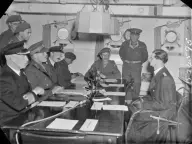
In February 1942, you are a Briton called up for service and you refuse to bear arms. In the eyes of the law you are a conscientious objector, and your case falls to a , a local body placed under the authority of the rather than the army. Before 3 or 4 judges, you must set out your reasons — religious, political or moral — and accept that they will rule.
The memory of the Great War hangs over the scene. In 1916-1918, objectors had been treated harshly, many thrown into prison, some sent to the front against their will. The new law of 1939 aims to be more humane: it provides for unconditional exemption, assignment to civilian work of national importance, or enrolment in unarmed units.
But the tribunals remain uneven from one town to the next, and a poorly framed refusal can lead to a cell. Your answer will bind both your conscience and your liberty.
You must decide what to tell the judges: accept non-combatant service — stretcher-bearer in the , bomb disposal, civil defence — to serve without killing; ask to be assigned to civilian work of national interest, in agriculture or the mines, away from any military structure; or refuse all participation on grounds of conscience alone, at the risk of being sentenced to prison.
During the war, nearly 60,000 men and about 1,000 women sought conscientious objector status in the United Kingdom — a far larger and far better-treated movement than in 1916-1918. The local tribunals, under the , proved on the whole more tolerant: unconditional exemption remained rare, but roughly three-quarters of applicants were directed toward work of national importance or unarmed duties — agriculture, mining, stretcher-bearing, ambulance units such as the , or the assigned to logistical tasks. The most common outcome was conditional registration for civilian work of national importance: according to the official figures of May 1945, some 28,600 men, against about 14,600 placed in non-combatant duties, while about 12,000 applications were rejected. Rejection rates varied sharply from one tribunal to another. Some 5,500 objectors nonetheless went to prison, most often “absolutists” who refused any condition set by the tribunal, but repression remained far milder than during the First World War.



T10-099