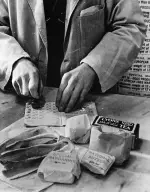
has been running, from the Military Council of the Front, a city the Germans cut off from the world in September. The flotilla, which was still bringing food in by boat, is trapped by the forming ice. On 8 November the fall of cut the last railway leading to the lake's eastern shore. Stocks are dwindling so fast that from 20 November the bread ration must fall to 250 grams for a factory worker and 125 for everyone else, children included.
Only 1 opening remains: Lake , which is beginning to freeze. Between on the eastern shore and on the besieged side, a track some 30 kilometres long could be laid across the ice. But in places the ice is only about 10 centimetres thick, when some 20 are needed to bear a truck carrying 1 tonne.
Every day of waiting is paid for in deaths from starvation in frozen apartments; every truck sent out too early risks breaking through the ice with its driver.
Zhdanov and the Military Council must decide: order an ice road at once and send horses, then trucks, across it despite the losses; ration even more harshly and wait for safe ice; or concentrate forces on a military breakthrough, toward or across the , to reopen a land corridor.
On 19 November the Military Council of the Front ordered the ice road built between and . A first convoy of horse-drawn sledges set out across the lake straight away; on the night of 22 November a column of 60 trucks reached the besieged shore. The beginning was terrible: the ice gave way, trucks sank, and for weeks deliveries fell far short of needs while famine killed tens of thousands. The 's recapture of on 9 December gradually restored rail access to the lake, and growing deliveries allowed the Military Council to raise the ration on 25 December, to 350 grams for workers and 200 for everyone else. From 22 January to mid-April 1942, more than 550,000 civilians were evacuated across the ice. Named the , the track became 's lifeline; the siege was lifted only in January 1944, after nearly 900 days.
T10-032